
PEX-CM100-D
PEX-CM100-D
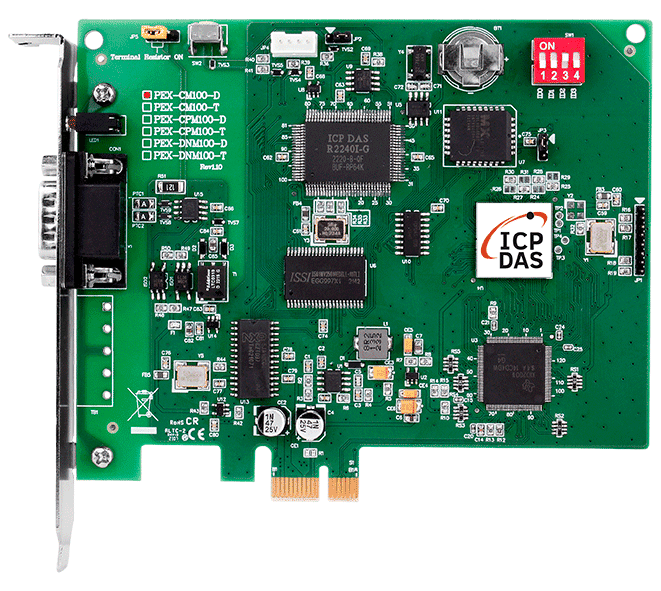
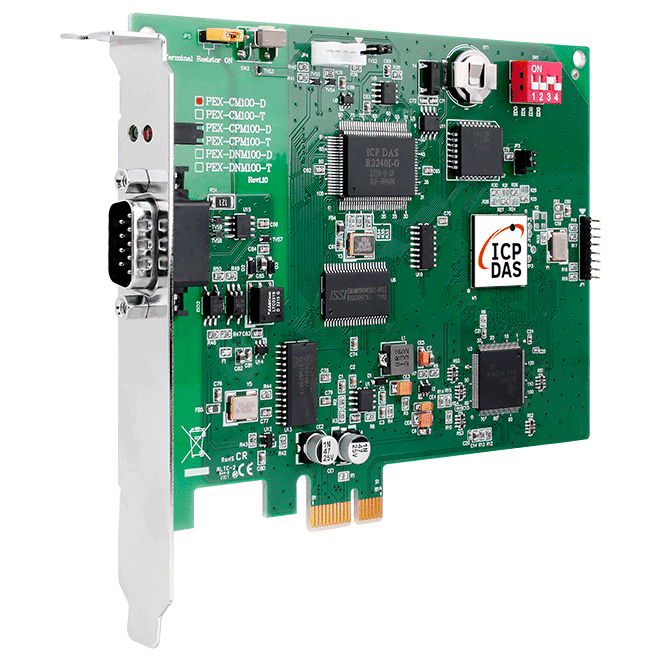
1-port Programmable CAN PCI Express Board (9-pin D-Sub Connector)
Features
- Built-in default firmware for CAN Port communication
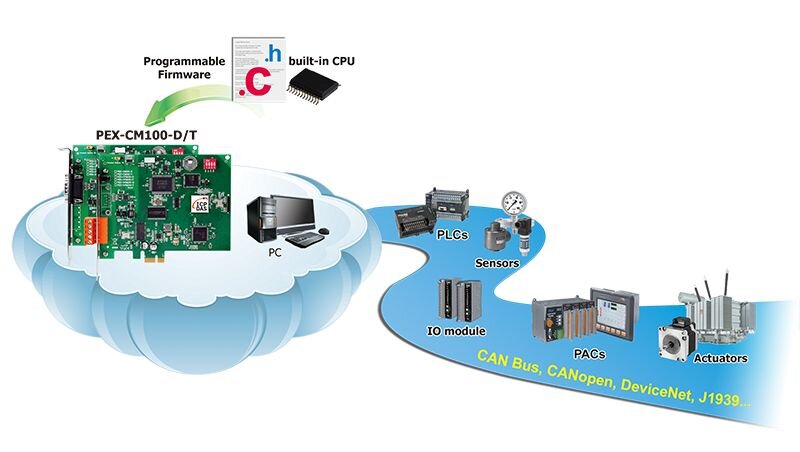
- User-defined firmware executable
- Support both CAN 2.0A and CAN 2.0B
- Allow user-defined CAN baud
- Provide 5 sets of cyclic transmission
- Timestamp with at least ±1ms precision
- Build-in 120Ω Jumper
- DIP switch to select board number
- Dual port RAM communication mechanism
- RTC (real time clock) inside
- PC-side monitoring software for user-defined firmware debugging
- Introduction
- Application
- Specification
- Download
- Get A Quote
Introduction
The CAN (Controller Area Network) is a serial communication protocol, and efficiently supports distributed real-time control with a very high level of security. It is an especially suited for networking "intelligent" devices as well as sensors and actuators within a system or sub-system. In CAN networks, there is no addressing of subscribers or stations in the conventional sense, but instead prioritized messages are transmitted.
ICP DAS provides an open architecture platform for CAN bus PEX-CM100. The PEX-CM100 represents a very powerful and economic solution of an active CAN board with one CAN channels, covering a wide range of CAN applications. The 16-bit on-board microcontroller allows, among many other features, the filtering, preprocessing, and storage (with timestamp) of CAN messages as well as the real-time transmission of CAN messages. PEX-CM100 also uses the new Phillips SJA1000T and Transceiver 82C250/251, which provide bus arbitration and error detection with auto correction and re-transmission function. Under the effect of the powerful microcontroller, this card can be made for one CAN controller without losing data, even in systems with a high bus load. Besides, equipped with integrated intelligence functions, the PEX-CM100 makes it is possible to preprocess CAN data streams, thus relieving the PC of a considerable burden. As a result, real-time requirements on the PC applications are drastically reduced. Due to the state-of-the-art, it can be installed in a slot of PCI Express bus and supported truly “Plug & play” technology.
In addition, users can develop their own CAN application by using the PEX-CM100 library. When the PEX-CM100 is active, the data exchange between users’ application and can bus firmware is performed via the memory mapping method of the PEX-CM100.
| Model | Intelligent PCI / PCIe / PCI-104 CAN Card | ||
|---|---|---|---|
| Module Name | PISO-CM100U-D | PEX-CM100-D | PISO-CM200U-D |
| PISO-CM100U-T | PEX-CM100-T | PISO-CM200U-T | |
| Hardware | |||
| PC Bus Interface | Universal PCI | PCI Express | Universal PCI |
| On-board CPU | 80186, 80 MHz | 32-bit MCU | |
| On-board OS | MiniOS7 | N/A | |
| On-board Firmware | Programmable | N/A | |
| Firmware SDK |
Turbo C 2.01, Turbo C++ 1.01, Borland C++ 3.01 |
N/A | |
| CAN Interface | |||
| Channel Number | 1 | 2 | |
| Baud Rate (bps) | 10k ~ 1M (user-defined) | ||
| CAN Filter | Yes | ||
| CAN Isolation | 1000 VDC / 2500 Vrms | 3000 VDC / 3000 Vrms | |
| Terminal Resistor | Built-in 120Ω | ||
| Driver | |||
| DLL Library |
VB 6.0, VC++ 6.0, Delphi, C#.Net, VB.Net |
C#.Net, VB.Net, VC++.Net | |
| Windows Driver | Windows XP / 7 / 8 / 10 | Windows XP / 7 / 8.1 / 10 | |
| InduSoft Driver | Yes | N/A | |
| LabVIEW Driver | Yes | N/A | |
Application
Specification
| Software | |
|---|---|
| Driver Support |
Windows XP / 7 / 8 / 10 (32-bit & 64-bit) InduSoft |
| SDK |
VB 6.0, VC++ 6.0, BCB 6.0, Delphi 4.0, C# 2008 |
| CPU Module | |
|---|---|
| CPU | 80186 (80 MHz) or compatible |
| EEPROM | 16 KB |
| Flash Memory | 512 KB |
| NVRAM | 31 bytes (battery backup, data retention up to 10 years) |
| SRAM | 512 KB |
| Real-Time Clock | Yes |
| LED Indicators | |
|---|---|
| Status |
1 × CAN Status 1 × Operating Mode |
| PC Bus | |
|---|---|
| Bus Type | PCI Express |
| Board Number Setting | Configurable via DIP switch |
| CAN | |
|---|---|
| Controller | NXP SJA1000T (16 MHz clock) |
| Ports | 1 |
| Baud Rate | 10 kbps ~ 1 Mbps |
| Isolation |
3000 VDC (DC-to-DC) 2500 Vrms (Opto-isolation) |
| Terminal Resistor | 120 Ω termination resistor (jumper selectable) |
| Power | |
|---|---|
| Power Consumption | 300 mA @ 5 V |
| Mechanical | |
|---|---|
| Dimensions (mm) | 133 × 22 × 98 (W × L × H) |
| Environment | |
|---|---|
| Operating Temperature | 0 ~ +60 °C |
| Storage Temperature | -20 ~ +70 °C |
| Humidity | 5 ~ 85% RH, Non-condensing |
Download


