
CAN-2019D/S
CAN-2019D/S
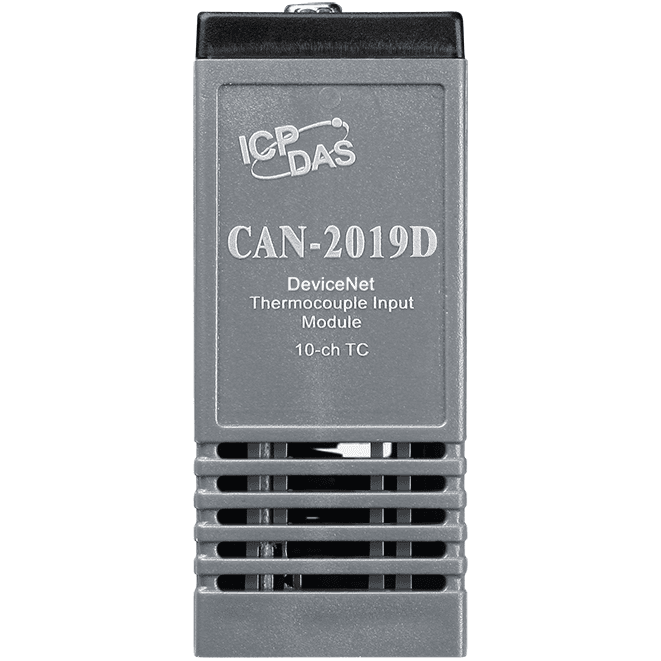
DeviceNet Slave Module of 10-channel Universal AI
Features
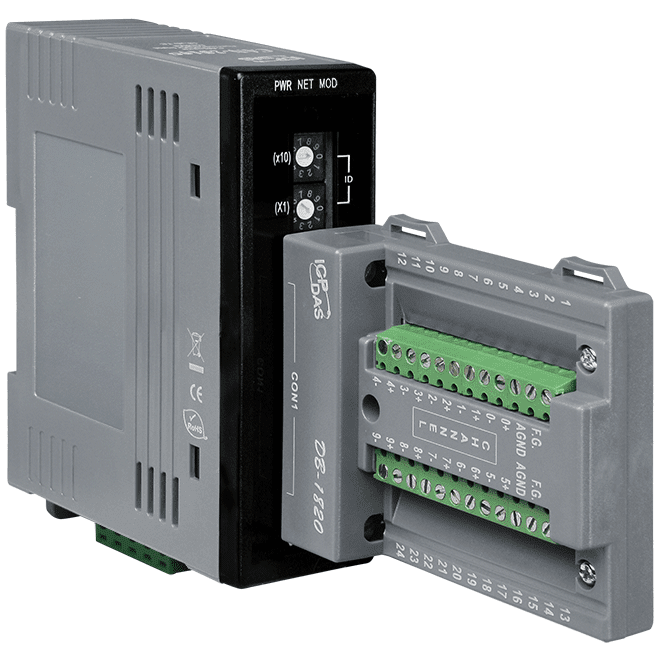
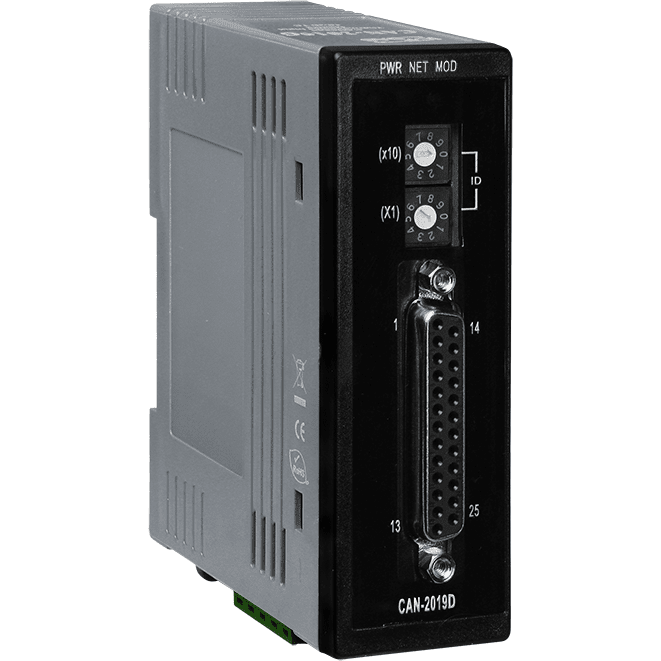
- 10-channel, 16-bit resolution thermocouple input DeviceNet slave general-purpose I/O device
- Comply with DeviceNet specification Volume I, Release 2.0 & Volume II, Release 2.0, Errata 5
- Group 2 Only Server (non UCMM-capable)
- Connection supported:
- • 1 connection for Explicit Messaging
- • 1 connection for Polled I/O
- • 1 connection for Bit-Strobe I/O connection
- • Support DeviceNet Heartbeat and Shutdown message
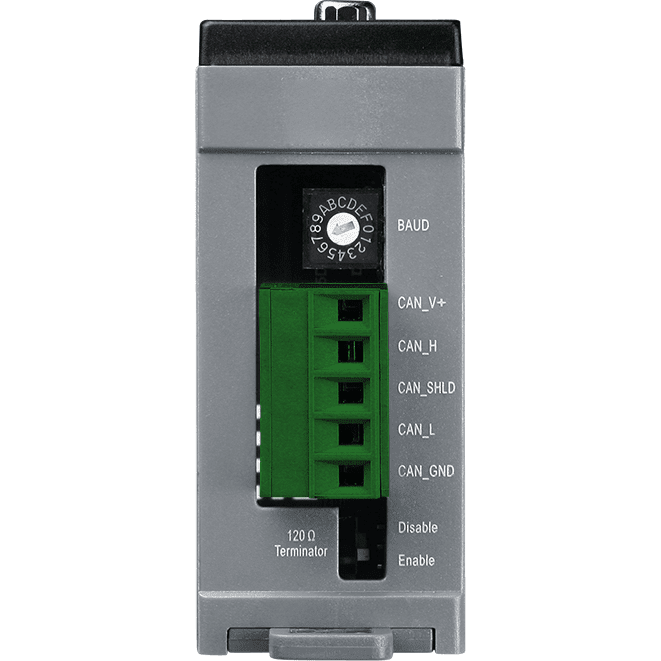
- • Set the DeviceNet device station number and baud rate through the rotary switch
- Provide EDS file for DeviceNet master interface
- LED indicators for power and DeviceNet status
- Introduction
- Application
- Specification
- Download
- Get A Quote
Introduction
DeviceNet is one kind of the network protocols based on the CAN bus and mainly used for the embedded network of the machine control, such as industrial machine control , aircraft engines monitoring, factory automation, medical equipments control, remote data acquisition, environmental monitoring, and packaging machines control, etc. The CAN-2019D/S follows DeviceNet specification Volume I/II, Release 2.0. User can access the thermocouple input status and set the configuration via DeviceNet EDS file. CAN-2019D/S has 10-channel thermocouple input and it can be used to various applications. By the DeviceNet masters of ICP DAS, you can quickly build a DeviceNet network to approach your requirements. For more information about the DeviceNet master interfaces and other DeviceNet products, please refer to the following web site.
Analog I/O Modules
| Model | Analog Input | Analog Output | |||
|---|---|---|---|---|---|
| Channels | Input Range | Sensor | Channels | Output Range | |
| CAN-2012D | 8 Diff / 16 S.E | ±10V, ±5V, ±2.5V, 0–10V, ±20mA, 0–20mA, 4–20mA | — | — | — |
| CAN-2017D | 8 |
±10V, ±5V, ±1V, ±500mV, ±150mV, ±20mA (with external 125Ω resistor) |
— | — | — |
| CAN-2018D/S | 8 |
±2.5V, ±1V, ±500mV, ±100mV, ±50mV, ±15mV, ±20mA (with external 125Ω resistor) |
Thermocouple (J, K, T, E, R, S, B, N, C) |
— | — |
|
CAN-2019D/S CAN-2019D/S2 |
10 |
±15mV, ±50mV, ±100mV, ±500mV, ±1V, ±2.5V, ±5V, ±10V, ±20mA (requires external 125Ω resistor) |
Thermocouple (J, K, T, E, R, S, B, N, C) |
— | — |
| CAN-2024D | — | — | — | 4 | 0–5V, ±5V, 0–10V, ±10V, 0–20mA, 4–20mA |
Application
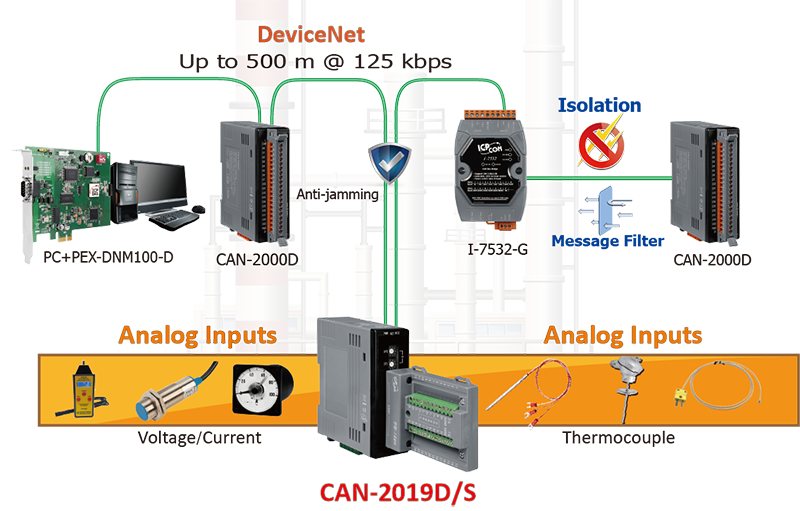
Specification
| LED Indicators | |
|---|---|
| Status |
1 × Power 2 × DeviceNet Status |
| Analog Input | |
|---|---|
| Channels | 10 (Differential) |
| Sensor Type |
±15 mV, ±50 mV, ±100 mV, ±500 mV, ±1 V, ±2.5 V, ±5 V, ±10 V ±20 mA (Requires Optional External 125 Ω Resistor) Thermocouple (J, K, T, E, R, S, B, N, C) |
| Resolution | 16-bit |
| Accuracy | ±0.1% FSR |
| Sampling Rate | 10 Samples/sec (Total) |
| Input Impedance | > 400 kΩ |
| Common Mode Rejection | 86 dB (Min.) |
| Normal Mode Rejection | 100 dB |
| Overvoltage Protection | 240 Vrms |
| Individual Channel Configuration | Yes |
| Open Wire Detection | Yes |
| Zero Drift | ±10 μV/°C |
| Span Drift | ±25 ppm/°C |
| Intra-module Isolation | 3000 VDC |
| DeviceNet | |
|---|---|
| Ports | 1 |
| Connection Supported |
1 Connection for Explicit Messaging 1 Connection for Polled I/O 1 Connection for Bit-Strobe I/O |
| Baud Rate | 125 kbps, 250 kbps, 500 kbps |
| Terminal Resistor | Switch for 120 Ω Terminal Resistor |
| Specification | Volume I, Release 2.0 & Volume II, Release 2.0 (Errata 5) |
| Node ID | 0 – 63 |
| Shutdown Message | Yes |
| Heartbeat Message | Yes |
| Subscribe | Group 2 Only Server |
| Power | |
|---|---|
| Input Range | +10 VDC – +30 VDC |
| Consumption | 1.5 W |
| Mechanical | |
|---|---|
| Dimensions (mm) | 33 × 99 × 78 (W × L × H) |
| Installation | DIN Rail |
| Environment | |
|---|---|
| Operating Temperature | −25 °C – +75 °C |
| Storage Temperature | −30 °C – +80 °C |
| Humidity | 10 – 90% RH, Non-condensing |
Download


